Turning Infrastructure as a Product: The Business Case for Abstraction-First IT
Learn how CXL, DPUs, eBPF, and Wasm enable Abstraction-First IT—a framework that shifts infrastructure as a product from a sunk cost to a monetizable platform, delivering up to 25% savings and new revenue streams. Stop "keeping the lights on" and start "monetizing the stack."
Imran Ahmad
11/2/20254 min read
How Software–Hardware Abstraction Layers Are Rewriting the Economics of Enterprise Infrastructure
For two decades, enterprises treated hardware as a sunk cost - a silent, static layer beneath the cloud. That mental model is officially broken.
The world has changed: AI-centric workloads, edge computing, and heterogeneous silicon (CPUs + GPUs + DPUs + NPUs) are dissolving the line between software and hardware. This shift gives rise to Abstraction-First IT: infrastructures engineered as programmable, composable, and, crucially, monetizable products.
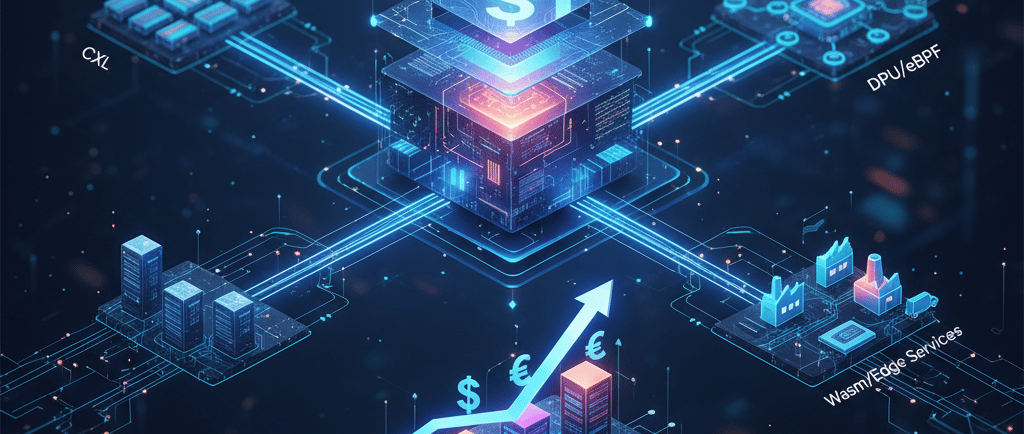
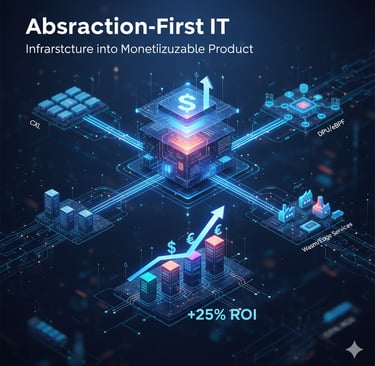
This transformation is powered by emerging technologies like Compute Express Link (CXL), Data Processing Units (DPUs), WebAssembly (Wasm), and extended Berkeley Packet Filter (eBPF). Together, they let enterprises re-architect data centers into AI-ready, policy-driven fabrics that translate directly into:
Cost Optimization
Faster Time-to-Market
New Business Models
Why Now: The Economic Timing Is Perfect
The pressure on IT budgets and performance is unprecedented. Abstraction-First IT offers a strategic answer to four major economic forces:
The AI Workload Crunch: Foundation model training and real-time inference have pushed memory and bandwidth costs to up to 60% of total infrastructure spend. CXL-based memory disaggregation allows pooling and "near-data compute," dramatically cutting latency and power draw.
Cloud Cost Inflation: Cloud OPEX has outpaced revenue growth for many. Abstracted, hardware-aware platforms reclaim control by dynamically assigning compute and memory across on-prem, colocation, and cloud nodes—a true FinOps-meets architecture play.
Edge Proliferation & Data Gravity: Data no longer travels; compute does. DPUs and Wasm runtimes move processing to data sources (factories, retail, vehicles), slashing egress fees and meeting data-sovereignty mandates.
Regulatory & ESG Pressures: eBPF-based observability and DPU telemetry create auditable performance and energy metrics, aligning IT efficiency with sustainability reporting (e.g., EU CSRD).
From Cost Center to Product Platform
Abstraction-First IT fundamentally changes the CIO scorecard, replacing uptime and budget adherence with revenue-adjacent KPIs. Infrastructure becomes a measurable, improvable, and monetizable product.
Here is how the view of IT success changes:
Infrastructure Utilization: Shifts from a Legacy IT view of 50–60% average to an Abstraction-First view of > 85% via pooled memory & compute.
Feature Delivery Cycle: Shifts from Quarterly to Continuous via policy-driven runtimes.
Security Policy Change: Moves from Manual, OS-level to Instant, via eBPF policy push.
Infra OPEX (3-year CAGR): Improves from +10% to a 15–25% reduction through offloads & disaggregation.
New Revenue Streams: Shifts from None to Platform APIs, edge services, infra licensing.
In other words, infrastructure becomes a product - measurable, improvable, and monetizable.
The Architecture Behind the Value
The new stack is built on three programmable layers:
Hardware Abstraction Layer (HAL 2.0)
CXL-enabled disaggregation turns memory and accelerators into fluid, pooled resources.
DPUs/SmartNICs handle data-plane compute (encryption, telemetry) independently of host CPUs.
Outcome: 30–40% higher compute utilization, 20% lower power usage.
Software Abstraction Layer (SAL)
eBPF introduces safe, in-kernel programmability for deep observability and policy enforcement.
WebAssembly (Wasm) enables sandboxed, portable micro-services deployable from data center to edge.
Outcome: Sub-millisecond policy updates, accelerated CI/CD, and faster time-to-insight.
Control & Policy Plane
A unified API layer manages resource allocation, compliance, and performance SLAs across all disaggregated components.
Ties directly into enterprise FinOps dashboards for real-time cost/performance governance.
Financial Modeling: Quantifying the ROI
Let’s analyze a hypothetical $200M/year IT budget at a Fortune 500 enterprise. Abstraction-First IT delivers a $20M+ annual improvement with an expected 10% ROI within 18 months, driven by:
Memory Disaggregation (CXL):
Baseline Cost: $30 Million/year
Savings: $8 Million
Mechanism: 25% fewer servers due to pooled, fluid memory.
Network Offload (DPU):
Baseline Cost: $20 Million/year
Savings: $5 Million
Mechanism: Host CPU freed from resource-intensive packet processing.
Observability Automation (eBPF):
Baseline Cost: $15 Million/year
Savings: $3 Million
Mechanism: Reduced tool licensing and accelerated mean-time-to-resolution (MTTR) for alerts.
Edge Service Enablement (Wasm):
New Revenue: $4 Million Gain
Mechanism: Launching paid API or localized analytics services.
Beyond direct savings, CFOs also see:
Depreciation flexibility via composable resources.
Lower cloud egress (5–8% reduction) through edge compute.
Faster innovation velocity—a strategic, intangible but material advantage.
Organizational Roadmap: From Infrastructure Ops to Platform Product Teams
This is a strategic shift, not a feature rollout. Follow this three-stage plan:
Stage 1: Audit & Abstract
Inventory workloads and identify bottlenecks.
Pilot CXL pooling (memory-intensive analytics) and DPU offload (network-heavy services).
Validate non-intrusive kernel programmability with eBPF observability.
Stage 2: Platformize the Stack
Establish a Platform Engineering team reporting jointly to the CIO & CTO.
Productize infrastructure APIs: memory pools, telemetry feeds, policy triggers.
Integrate FinOps metrics directly into resource orchestration dashboards.
Stage 3: Monetize & Differentiate
Expose high-performance, compliant capabilities to internal or external customers.
Offer "AI Inference-as-a-Service" or "Edge Analytics as-a-Service" using Wasm modules.
Create billing and SLO constructs, treating infrastructure as a product SKU.
Governance and Risk Considerations
The stack is closer to the metal, requiring diligence:
Verification & Security: All eBPF/Wasm modules must pass signature and runtime verification; treat kernel-level execution as regulated code.
Vendor Ecosystem Volatility: CXL standards are evolving; maintain dual-vendor strategies for memory controllers and DPUs.
Skill Gap: Invest in Platform SRE + Kernel Developer cross-training; this is the largest bottleneck in implementation.
Key Performance Indicators (KPIs) for the C-Suite
The C-suite needs to measure strategic success, not just uptime:
Infrastructure ROI Velocity: Months to payback of hardware-software co-design.
Abstraction Coverage Ratio: Percentage of workloads running on programmable (eBPF/Wasm) layers.
Policy Deployment Latency: Time to roll out a new security or compliance rule across clusters.
Platform Revenue Contribution: Percentage of total revenue influenced or enabled by platform APIs.
Future Outlook: The Convergence Era
Within five years, software - hardware co-design will no longer be optional:
Memory becomes elastic with CXL 3.0.
Networking becomes intelligent as DPUs execute micro-AI models at line speed.
Applications become location-agnostic as Wasm workloads migrate seamlessly.
Operations become autonomous as eBPF-driven telemetry fuels AI Ops.
The term “data center” will feel outdated. Enterprises will operate programmable micro-grids of compute, each monetized and governed as an internal market.
Conclusion: Turning Complexity into Competitive Advantage
Abstraction-First IT is not an incremental optimization - it’s a strategic inversion.
Leading enterprises are embracing controlled complexity to capture business agility and financial leverage. The winners will:
Build cross-disciplinary platform teams fluent in hardware and software abstraction.
Treat infrastructure as code and policy as product.
Continuously measure business value per watt, per byte, per policy.
The question is no longer “Should we modernize the stack?” It’s “How quickly can we turn our stack into a product?”
Contact
Get in touch: connect@ea-chat.com
Subscribe
© 2024. All rights reserved.