
Retail Strategy: Margin Defense in a Poly-Crisis Economy
In a challenging low-growth economy, retail CIOs are leveraging next-generation personalization engines and generative AI to defend margins as part of their retail strategy. This article discusses strategies for reducing customer ...
Imran Ahmad
12/7/20253 min read
Margin Defenders: Why the CIO is Your New Chief Profitability Officer
EXECUTIVE BRIEF
The era of "growth at all costs" fueled by cheap capital is dead. We have entered the "poly-crisis" - a persistent state of economic drag defined by high inflation, market saturation, and expensive borrowing. For retail Boards, the mandate has shifted violently from "expand territory" to "defend margins".
In this unforgiving landscape, the old playbook of "buying growth" is unsustainable because Customer Acquisition Costs (CAC) have skyrocketed. The only viable path to profitability is radically increasing the Lifetime Value (LTV) of existing customers through ruthless efficiency.
Enter the Retail CIO. No longer just the custodian of uptime, the modern CIO is emerging as the enterprise's Chief Profitability Officer. Their weapon is the next-generation Personalization Engine - a system designed to transmute raw data into immediate margin lift.
This is the business case for Algorithmic Retailing.
The Leaky Bucket: Why Old Tech is Killing Your P&L
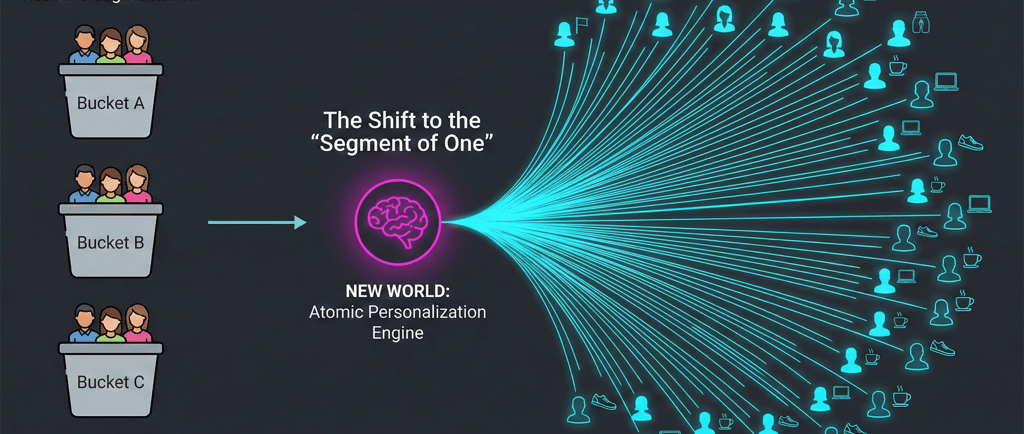
Legacy retail strategy relied on a "spray and pray" approach: buy traffic, convert a fraction, and ignore the churn.
In a high-growth market, rising tides hide this inefficiency; in a low-growth market, it is fatal bleeding.
Most retailers are currently bleeding margin in three invisible ways:
Wasted Ad Spend: Targeting customers with generic offers they ignore.
Markdown Addiction: Slashing prices to clear inventory that shouldn't have been bought in the first place.
Churn: Losing high-value customers to competitors who offer better digital experiences.
The strategic pivot requires moving from Reactive Personalization (looking at what happened) to Predictive Demand Shaping (influencing what will happen).
The New Math: How Personalization Engines Print Margin
To the CFO, a "Personalization Engine" often sounds like a soft marketing expense, but it is a hard deflationary asset. By leveraging Generative AI and Composable Architectures, CIOs are deploying systems that directly attack the cost centers of the P&L.
A. Compressing CAC with Zero-Party Data
As third-party cookies crumble under privacy regulations, "renting" audiences from big tech is becoming prohibitively expensive. The new margin play is owning the relationship.
Modern engines facilitate a "Value Exchange": they compellingly ask customers for preferences (Zero-Party Data) in return for hyper-relevant curation.
The P&L Impact: When you know exactly what a customer wants because they told you, you don't waste ad spend guessing. Conversion rates on zero-party data segments can be 2-3x higher than third-party lookalikes.
B. Inventory Optimization via "Agentic AI"
We are moving toward Agentic AI - systems that don't just recommend products but actively manage demand. A sophisticated engine can analyze real-time inventory gluts and dynamically adjust the "personalization algorithm" to surface those specific overstocked items to the customers most likely to buy them at full price.
The P&L Impact: This is Predictive Demand Shaping. Instead of a blanket 30% markdown across the board (which is margin destruction), the AI surgically targets offer to clear inventory while preserving the highest possible price point.
C. Lifting AOV with "Atomic Content"
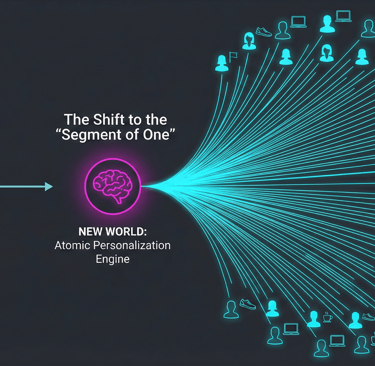
Generative AI allows for Atomic Content Personalization. Instead of pre-made marketing segments, GenAI assembles unique product bundles, descriptions, and visual assets for every single interaction in milliseconds.
The P&L Impact: By contextualizing the bundle (e.g., suggesting a specific belt that matches the pants and the shoes the customer just viewed), Average Order Value (AOV) increases without increasing the cost of goods sold.
The Strategic Framework: Calculating "mROI"
For the CEO and Board, the metric for success must shift. We are not measuring "clicks" or "impressions". We are measuring Margin Lift.
Here is a framework for evaluating your CIO's personalization strategy:
Phase 1: The Efficiency Audit
Question: Is our current tech stack a monolithic suite (high maintenance, low agility) or a MACH (Microservices, API-first, Cloud-native, Headless) architecture?
Margin Goal: Reduce the Total Cost of Ownership (TCO) of the tech stack while increasing speed-to-market for new features.
Phase 2: The Conversion Velocity
Question: How fast does a "cold" lead turn into a "profitable" customer?
Margin Goal: Reduce "Time to First Value." Use GenAI to onboard customers faster with personalized tutorials or starter guides.
Phase 3: The Retention Defense
Question: What is our "Save Rate" for at-risk customers?
Margin Goal: Deploy predictive churn models. If the AI detects a high-value customer is fading, it automatically triggers a high-margin retention offer (e.g., exclusive access rather than a discount) to keep them.
Contact
Get in touch: connect@ea-chat.com
Subscribe
© 2024. All rights reserved.