Retail IoT 3.0: Transforming Stores with AI & 5G
Explore how Retail IoT 3.0 is revolutionizing the retail industry with edge AI, digital twins, and 5G connectivity. This article provides insights for CTOs, CIOs, and innovation leaders on architec...
Imran Ahmad
12/29/20253 min read
🔵 Introduction — The Shift from “Connected Stores” to Autonomous Retail Systems
Retail IoT is undergoing a generational reset.
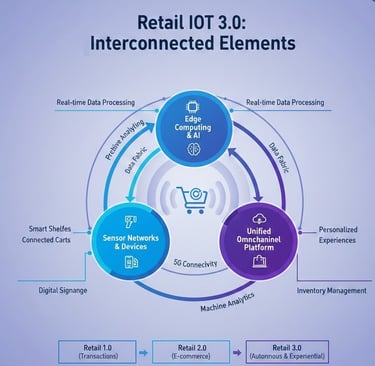
Retail IoT 1.0 was about connectivity: Attaching RFID tags, sensors, and smart shelves.
Retail IoT 2.0 was about visibility: Dashboards, analytics, and centralized monitoring.
Retail IoT 3.0 represents a quantum leap forward. It is about self-optimizing ecosystems, where stores don’t just collect data - they think, adapt, and autonomously optimize outcomes in real time. Enabled by edge AI + digital twins + privacy-aware intelligence + 5G networks, Retail IoT 3.0 transforms stores into cognitively aware, operationally autonomous, and continuously learning ecosystems.
This is architectural, not incremental.
🔵 Why Retail IoT 3.0 Is Emerging Now
A convergence of macro forces is pushing retail beyond traditional capability thresholds:
Surging demand for zero-latency operations
Margin pressure + shrink escalation
Workforce volatility
Experience-driven consumer expectations
Regulatory tightening over privacy & governance
Sustainability requirements & ESG mandates
Simply put, retail needs intelligence that acts instantly.
Cloud-only architecture can’t keep up.
Batch analytics can’t keep up.
Human decision loops can’t keep up.
Retail IoT 3.0 solves this by pushing cognition to the edge, orchestrating intelligence across the store, and synchronizing outcomes enterprise-wide.
🔵 The Technical Foundation of Retail IoT 3.0
Retail IoT 3.0 is built on five core engineering pillars.
🧠 ⃣ Edge AI & Autonomous Decision Execution
At the heart of Retail IoT 3.0 is the collapse of cloud dependency for mission-critical decisions.
What Changes Technically
Instead of piping raw IoT data to the cloud for processing, decisions are executed at the edge:
Computer vision inference on in-store devices
Queue management optimization in milliseconds
Hazard & shrink detection without cloud round-trip
Dynamic pricing adjustments executed locally
In-aisle contextual assistance triggered instantly
Architectural Enablers
Edge inference engines (e.g. TensorRT, ONNX Runtime, OpenVINO)
Micro-model deployment frameworks
Event-driven architecture
AI model lifecycle management at the edge
Federated learning to ensure privacy-respecting model improvement
Why This Matters
Latency is no longer a UX problem.
Latency is an operational risk, revenue leak, and safety liability.
Retail IoT 3.0 transforms stores into real-time autonomous systems.
🛰️ ⃣ Digital Twins - The Cognitive Nervous System of the Retail Store
Digital twins move beyond industry hype - they become the operational nervous system of next-gen retail.
A Retail Digital Twin creates a virtual replica of:
Traffic heatmaps
Product velocity
Checkout dynamics
Workforce movement
Shelf state
Environmental conditions
Engineering Capabilities Enabled
Run simulated store layouts before physical change
Test workforce optimization before deployment
Simulate price strategies without revenue risk
Predict energy consumption patterns
Model shrink risk hotspots
Technology Stack
Graph-based data platforms
Real-time telemetry ingestion
Predictive insight layer
Visualization + simulation engine
Closed-loop integration into operational systems
Digital twins turn retail operations from reaction-based → predictive → self-optimizing.
⚙️ ⃣ Autonomous Orchestration - Stores That Self-Run
Retail IoT 3.0 isn’t just about smart devices.
It’s about systems that coordinate themselves.
Retail Use Cases
POS queues balance automatically
Staff dynamically reallocated based on store load
Restock triggered autonomously by shelf state
Robots coordinate with human workers
Interactive displays adjust to demographic presence
Store security posture adapts in real time
What Enables This
Distributed orchestration platforms
Real-time event processing
AI decision agents
Policy engines for constraint-bound automation
Intent-based workflows
Retail IoT 3.0 introduces self-healing, self-scaling, and self-optimizing retail systems.
🌐 ⃣ 5G + Private Networks + Zero-Latency Fabric
Retail IoT 3.0 relies on networking that is:
deterministic
ultra-low latency
highly secure
scalable across thousands of stores
Network Innovations Driving This
5G SA + Private 5G
Wi-Fi 6E
Time-sensitive networking
Network slicing
Secure data enclaves
Networking is no longer infrastructure.
Networking is a strategic capability.
🔐 ⃣ Trust, Privacy & Cyber - The Governance Brain
Retail IoT 3.0 cannot succeed without trust-by-design engineering.
Security Architecture Requirements
Zero Trust IoT fabric
Continuous device validation
Hardware-backed identity
Secure ML pipelines
Policy-driven privacy enforcement
Ethics and bias governance controls
GDPR / CCPA aligned design models
Retailers that build autonomous intelligence must build autonomous trust.
🔵 Real-World Capability Examples
Here is where Retail IoT 3.0 becomes tangible:
Autonomous Workforce Allocation:
System predicts rush → deploys staff → adjusts checkout → sends micro-tasksAI-Driven Loss Prevention
Computer vision detects risk → evaluates → triggers action — without human bottlenecksSmart Supply Chain Synchronization
Shelf → edge → procurement → warehouse → replenishment — automatically alignedExperience Personalization
Edge intelligence aligns content, offers, and assistance dynamically
This isn’t “innovation theater.”
This is operational transformation.
🔵 Challenges CIOs & CTOs Must Solve
Retail IoT 3.0 is powerful but hard.
System interoperability complexity
AI governance maturity gaps
Skilled workforce requirements
Vendor ecosystem fragmentation
CapEx vs OpEx balancing
Privacy ethics readiness
Network modernization necessity
Leadership requires roadmaps, reference architectures, governance frameworks, and a mature change management approach.
🔵 Strategic Roadmap - How Retailers Can Get Started
1️⃣ Stabilize Core IoT Foundation
Standardize devices, protocols, and observability.
2️⃣ Deploy Edge AI Gradually
Start with CV analytics, queue optimization, and safety intelligence.
3️⃣ Introduce Digital Twin Layer
Pilot → iterate → operationalize.
4️⃣ Enable Autonomous Decisioning
Automate low-risk workloads first.
5️⃣ Architect Governance
Security + AI trust + compliance from day one.
6️⃣ Scale Across Store Networks
Move from pilots → portfolio-scale deployment.
🔵 Societal & Industry Impact
Retail IoT 3.0 will:
reshape workforce models
reduce waste & energy consumption
enhance sustainability
create safer retail environments
redefine experiential commerce
This is not a retail transformation.
This is a retail reboot.
Contact
Get in touch: connect@ea-chat.com
Subscribe
© 2024. All rights reserved.