Revolutionizing Retail AI for Autonomous Enterprises
Discover how the retail AI stack is transforming commerce by enabling autonomous, self-learning enterprises. Explore the layered AI architecture from edge intelligence to enterprise digital twins, allowing retailers to sense, simulate, and act in real time.
RETAIL
Imran Ahmad
2/2/20262 min read
A Strategic Brief for the Modern Enterprise
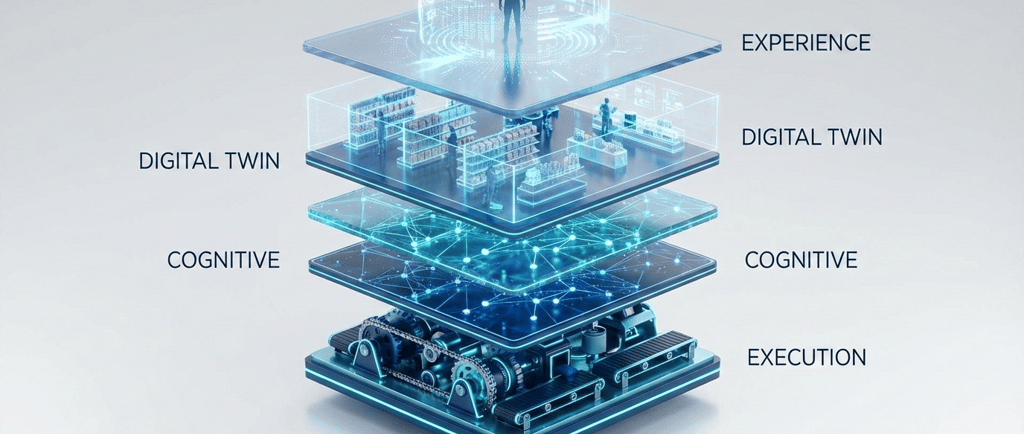
Retail is no longer merely digital; it has evolved into a state that is intelligent, autonomous, and predictive. In the wake of post-pandemic volatility and the explosive rise of generative AI, traditional, batch-oriented architectures have become critical bottlenecks. To achieve Retail 4.0 sovereignty, organizations must transition from static processes to a neural operating system for commerce, a composable, distributed ecosystem known as the Retail AI Stack.
The 6-Layer Architecture of Intelligence
This architectural shift elevates retail systems to the level of adaptive, cyber-physical economic organisms. It is built upon six foundational layers that integrate edge intelligence with enterprise-scale foresight.
1. The Experience Layer: Ambient Context & Zero UI
At the pinnacle of the stack is the customer-facing AI fabric. This layer utilizes multimodal models to understand voice, gesture, and visual signals, enabling Zero UI experiences where the environment anticipates a need before a customer even articulates it.
Key Capabilities: Adaptive interfaces, contextual personalization, and augmented reality engagement.
The Shift: Moving from active search to passive, ambient fulfillment.
2. Sensing & Edge Intelligence: Real-World Awareness
This layer transforms physical stores into thinking environments by ingesting data from smart shelves, RFID, computer vision, and environmental sensors.
The Tech: Lightweight neural inferencing powered by specialized silicon allows for real-time retail cognition at the edge.
The Impact: Localized inference minimizes latency while preserving data sovereignty.
3. Unified Data & Event Fabric: The Continuous Intelligence Backbone
Functioning as the enterprise’s nervous system, this layer unifies real-time streams—from supply chain telemetry to customer behavior.
Trend: Event-driven architectures (like Kafka and Pulsar) are replacing legacy batch systems, enabling decisions in milliseconds rather than hours.
The Impact: This creates "data gravity," ensuring that rapid decision loops are fueled by a single, continuous source of truth.
4. Cognitive & Decision Intelligence: The Predictive Brain
This is the heart of the Retail Digital Twin, where generative AI fuses with domain-specific optimization models to prescribe optimal actions.
Key Capabilities: Predictive demand forecasting, scenario simulation, and continuous reinforcement learning.
The Shift: Moving beyond simple "prediction" to autonomous choice within complex operational constraints.
5. Simulation & Digital Twin: The Enterprise Foresight Engine
Retailers are now maintaining living copies of their entire ecosystem, stores, supply chains, and customer journeys to simulate the future before executing in the physical world.
The Impact: Gartner and McKinsey identify digital twins as core drivers of AI ROI, with early adopters realizing 30–50% gains in efficiency by 2027.
Strategic Advantage: Enables multiscale "what-if" scenario planning and autonomous strategy evaluation.
6. Execution & Autonomous Orchestration: Zero-Touch Operations
The bottom layer activates intelligence into action through robotic fulfillment, dynamic pricing engines, and checkout-out-free store systems.
The Shift: Moving from human-mediated tasks to machine-scale orchestration.
The Future: AI pipelines now connect prediction directly to action, allowing for self-healing supply chains and automated procurement.
Strategic Use Cases: From Insight to Autonomy
Self-Healing Supply Chains: By fusing the Event Fabric (Layer 3) with Cognitive Intelligence (Layer 4), the system can detect global disruption and autonomously reroute inventory via the Execution Layer (Layer 6) without human intervention.
The "Thinking" Store: Edge Intelligence (Layer 2) recognizes customer distress or a shelf gap and triggers an immediate response, either a personalized offer in the Experience Layer (Layer 1) or a restock order in the Execution Layer (Layer 6).
Foresight-Led Strategy: Using the Digital Twin (Layer 5) to run thousands of "what-if" simulations on a new pricing model before rolling it out globally, ensuring maximum margin protection.
Why This Is Relevant Now
Modern retail faces unprecedented pressure: global disruptions, compressed margins, and skyrocketing customer expectations for frictionless, individualized experiences. Legacy architectures, siloed, batch-oriented, and human-mediated, simply cannot keep up.
The Retail AI Stack provides the only path forward, flipping the paradigm from reactive insights to proactive, machine-scale autonomy.
Contact
Get in touch: connect@ea-chat.com
Subscribe
© 2024. All rights reserved.