
AI Strategy Guide for Intelligent Store Environments
Discover a practical, architecture-driven playbook for retail leaders. Learn how to transition from AI strategy to real deployment with a maturity model, implementation roadmap, and KPI framework to enhance intelligent store environments and boost profitability.
3/2/20263 min read
From Strategy to Execution: A Retail AI Implementation Playbook
Retail has crossed the threshold from experimentation to operational AI. The conversation is no longer about whether intelligent systems will run the store; it’s about how to implement them to improve margin, resilience, and customer lifetime value measurably.
If the last wave of retail transformation digitized transactions, the next wave will autonomize operations. This playbook translates strategy into execution: architecture decisions, rollout sequencing, KPIs, and governance needed to operationalize AI across enterprise and store environments.
The Retail AI Maturity Model
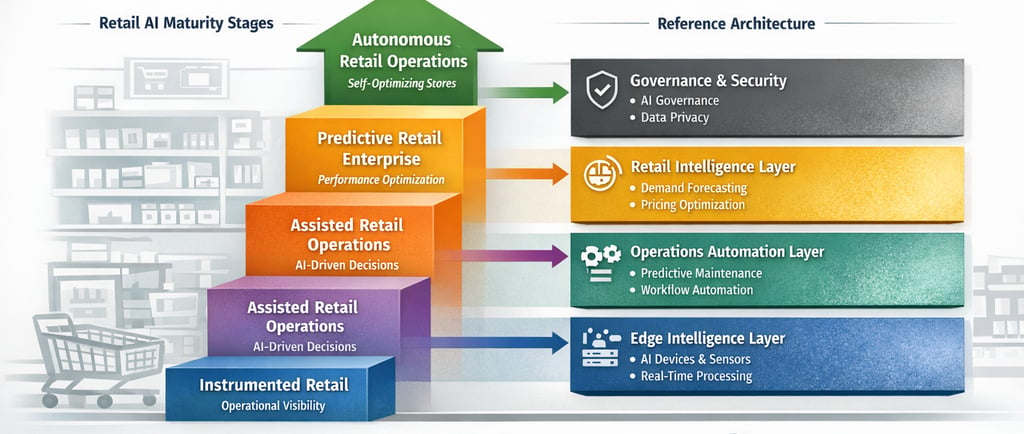
Retailers typically progress through four capability stages. Understanding where you are determines what to deploy next.
Level 1 - Instrumented Retail
Goal: Visibility
Capabilities
Unified device telemetry across POS, printers, kiosks, and handhelds
Centralized observability and incident tracking
Basic predictive alerts for device health
Business Outcome
Reduced downtime
Faster issue detection
Foundational data layer
Level 2 - Assisted Retail Operations
Goal: Decision support
Capabilities
AI-assisted workforce productivity tools
Demand sensing and inventory recommendations
Automated incident triage and resolution guidance
Business Outcome
Labor productivity improvement
Fewer stockouts
Faster Mean Time to Resolution (MTTR)
Level 3 - Predictive Retail Enterprise
Goal: Optimization
Capabilities
Cross-channel demand forecasting
Dynamic pricing and promotion orchestration
Predictive maintenance across store infrastructure
Business Outcome
Margin expansion
Inventory turnover improvement
Reduced operational volatility
Level 4 - Autonomous Retail Operations
Goal: Self-optimizing store ecosystem
Capabilities
Real-time decisioning at the edge
Self-healing endpoints
Continuous AI-driven store orchestration
Closed-loop learning from outcomes
Business Outcome
Structural cost reduction
Real-time margin optimization
Store as an adaptive system
Reference Architecture for AI-Driven Retail
Execution success depends on architectural clarity. The modern retail AI stack operates across four coordinated layers.
Edge Intelligence Layer
This is where physical retail becomes a digital system.
Components
AI-enabled endpoints (POS, cameras, sensors, kiosks)
Real-time inference engines
Store data gateway
Local decision services
Design Principle:
Process time-sensitive signals locally to minimize latency and bandwidth costs.
Operations Automation Layer
This layer converts insight into action.
Capabilities
Autonomous device management
Predictive maintenance orchestration
Workforce experience analytics
Incident automation workflows
Retailers commonly evaluate platforms such as HP Workforce Experience Platform and 1E for endpoint intelligence and automation.
Design Principle:
Every alert should have an automated or guided resolution path.
Retail Intelligence Layer
This is where enterprise value is created.
Capabilities
Demand forecasting models
Customer journey optimization
Pricing intelligence
Shrinkage prediction
Store performance optimization
Integration with enterprise AI ecosystems (e.g., Microsoft data and AI services) enables unified analytics across channels.
Design Principle:
Decisions must be measurable in financial terms.
Governance & Security Layer
Autonomy without control creates risk.
Capabilities
Model governance and lifecycle management
Data privacy enforcement
Edge AI policy controls
Compliance monitoring
Design Principle:
Operational AI must be auditable and reversible.
The 12-Month Implementation Roadmap
Retail transformation fails when deployment is not sequenced properly. The roadmap below reflects execution patterns observed in successful programs.
Phase 1 - Foundation (0–90 Days)
Objective: Establish visibility and control
Actions:
Deploy unified endpoint telemetry across stores
Standardize device management and monitoring
Establish baseline operational KPIs
Identify the top 5 sources of operational friction
Success Metrics:
Incident detection time
Store uptime baseline
Device health score
Phase 2 - Automation (90–180 Days)
Objective: Remove manual operational burden
Actions:
Implement automated remediation workflows
Deploy predictive maintenance models
Introduce AI-assisted support operations
Begin workforce productivity instrumentation
Success Metrics:
MTTR reduction
Service desk ticket volume
Labor hours saved per store
Phase 3 - Intelligence (6–12 Months)
Objective: Optimize business performance
Actions:
Deploy demand sensing models
Implement inventory optimization
Launch store performance analytics
Introduce real-time decisioning pilots
Success Metrics:
Inventory turnover
Gross margin improvement
Stockout frequency
Store EBITDA impact
KPI Framework: Measuring What Matters
AI programs fail when success is measured technically rather than economically. Retail leaders should track impact across four value domains.
Operational Efficiency
MTTR
Device uptime
Labor hours saved
Automation rate
Financial Performance
Gross margin uplift
Cost per transaction
Inventory carrying cost
Shrinkage reduction
Customer Experience
Checkout time
Conversion rate
Customer lifetime value
Personalization effectiveness
Technology Health
Model accuracy
Data freshness
System latency
Automation success rate
Organizational Model for Autonomous Retail
Technology implementation without organizational alignment creates friction.
Required Roles
AI Product Owner (business outcome ownership)
Retail Data Architect
Edge AI Operations Engineer
Automation Platform Lead
AI Governance Lead
Operating Model Shift
Retail IT evolves from:
System support → Experience engineering → Autonomous operations design
Risk & Governance Framework
Retail AI deployment introduces new operational and regulatory exposure. Governance must be designed, not bolted on.
Key Controls
Model approval workflow
Data lineage tracking
Human-override capability
Continuous performance auditing
Ethical AI guardrails
Strategic Principle:
Autonomy should always operate within defined business intent boundaries.
Strategic Impact: What Changes When Execution Succeeds
When retailers successfully implement this playbook, the store transforms from a transactional location into a real-time adaptive operating environment.
Structural shifts
Operations move from reactive to predictive
Labor shifts from routine tasks to exception handling
Technology moves from a support function to a profit lever
Enterprise architecture extends into physical environments
Closing Perspective
Retail transformation will not be defined by who deploys the most AI models, but by who operationalizes intelligence into everyday store decisions.
Execution - not experimentation is the competitive frontier.
Retailers that follow a structured implementation path will achieve three outcomes simultaneously:
Lower operating cost
Higher margin resilience
Adaptive, future-ready store operations
The question is no longer whether retail will become autonomous.
The real question is who will implement it first and correctly.
Contact
Get in touch: connect@ea-chat.com
Subscribe
© 2024. All rights reserved.