Beyond the Register: How 5G Network Slicing and SoftPOS Are Unleashing True Sales-Floor Mobility
Retail architecture is undergoing a quiet revolution. Fixed checkout counters are being eliminated as payments move to mobile, software-driven devices powered by 5G slicing, cellular IoT, and edge computing. This post explores how SoftPOS, PCI-MPOC compliance, and offline-first edge intelligence are creating the “floating POS”—a secure, highly mobile architecture that enables in-aisle transactions, drives operational agility, and reduces hardware dependency. The future of retail commerce isn’t tethered—it follows customer intent.
Imran Ahmad
11/24/20253 min read
Technical Deep Dive for Retail Architects
🚀 The Register Is Dead — Long Live the Floating POS
For decades, retail architecture revolved around a fixed, wired checkout station. That model is now obsolete.
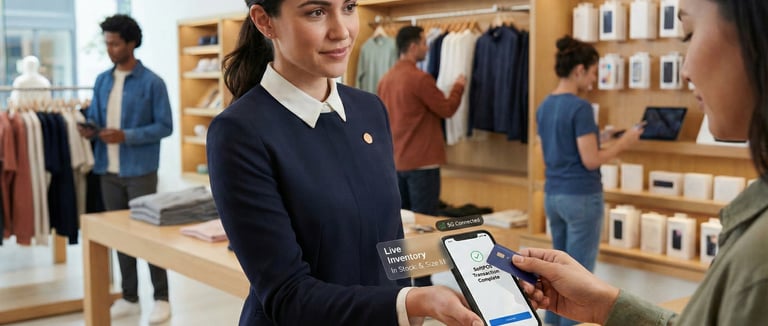
Mobile POS, SoftPOS, and 5G cellular-edge ecosystems are enabling “floating POS architectures”, where transactions occur anywhere - aisle, curbside, warehouse, or pop-up. What’s making this possible now isn’t just mobility, it’s the convergence of five technological shifts:
👉 5G Network Slicing - Guaranteed bandwidth, independent of guest Wi-Fi
👉 SoftPOS & MPoC - App-based payments on COTS mobile devices
👉 Retail Edge Computing - Low-latency, offline-first operations
👉 IoT Convergence - POS as a real-time control and sensing node
👉 Zero-Trust Cellular Architecture - Store network isolation for PCI DSS and cyber resilience
This is more than mobility - it’s revenue decentralization.
🎯 Why Now?
Standards like PCI-MPOC and updated EMVCo guidelines now authorize payments directly on Commercial Off-The-Shelf (COTS) mobile devices. 5G adoption across retail has reached the maturity necessary to support mission-critical operations. Meanwhile, edge computing allows low-latency performance for transaction, inventory, and clienteling capabilities - even during an internet outage.
Modern NPU-enabled edge devices can also process AI tasks locally, enabling fraud analysis, visual item recognition, and personalized recommendation logic in real time.
Retail transformation efforts are shifting from device replacement to capability expansion, driving a rapid decline in proprietary terminal demand and opening new revenue models based on embedded payment APIs and analytics services.
🔧 1. 5G Network Slicing - Killing the Retail "Dead Zone"
Problem: Wi-Fi-based POS fails due to overload (guest streaming, interference).
Solution: 5G network slicing isolates POS traffic into a dedicated virtual lane with SLA-backed latency & throughput.
Regardless of network congestion, POS transactions stay secure, fast, and unaffected.
✔ Eliminates Wi-Fi VLAN complexity
✔ Enables pop-up POS deployment
✔ Supports <50ms payment latency
Architecture Impact: POS devices should be cellular-native, not Wi-Fi dependent.
📱 2. SoftPOS & MPoC — The Appification of Hardware
SoftPOS (Software POS) + PCI’s MPOC (Mobile Payments over COTS) framework allows secure tap-to-pay directly on standard smartphones/tablets.
With this approach:
Hardware can be replaced via standard enterprise mobility procurement
Upgrades are handled through mobile app updates rather than device swaps
Retail associates use familiar devices (iOS/Android), improving adoption and reducing training efforts
The hardware lifecycle shifts away from vendor-driven terminal refresh cycles
“The sales associate’s smartphone becomes a secure payment terminal - no sleds, no dongles, no vendor lock-in.”
🧠 3. Edge Computing — Zero-Latency Intelligence
Retail edge servers handle inventory queries, customer service, push offers, and even AI recommendations locally.
🔹 Offline-first resilience: Transactions & inventory sync locally if external network fails
🔹 Hyperlocal performance: SKU inquiry, discount lookup, and loyalty verification processed <30ms
🔹 Edge AI: Predictive restock & cross-sell models run without cloud roundtrips
📌 Even if internet goes down, store-level operations continue.
Business critical for disaster recovery planning.
🌐 4. IoT Convergence - POS as a Sensor Hub
The new POS is no longer a terminal - it’s a command & control interface for warehouse, shelves, and replenishment automation.
Example Workflow:
Associate scans garment →
RFID input locates physical stock →
POS verifies difference from digital inventory →
If threshold reached → triggers auto-restock task →
Alert sent to BOH (Back of House) picker via IoT messaging.
📌 This is the true definition of Phygital (Physical + digital) retail.
🔒 5. Zero-Trust Security on Cellular
Traditional POS over Wi-Fi = exposed attack surface.
Cellular-native POS bypasses the store LAN entirely.
✔ eSIMs + private APNs → encrypted telecom tunnel
✔ No reliance on store wireless infrastructure
✔ PCI audit scope simplifies dramatically
From CISO perspective, cellular POS is the cleanest security perimeter in retail PCI architecture.
🧩 Core Architecture Strategy
Design POS as an edge endpoint rather than a device terminal.
Key architectural choices:
Cellular-first connectivity – Wi-Fi optional
Secure Enclave or TEE (Trusted Execution Environment) on device
SoftPOS application containerized and managed via MDM
Edge gateway responsible for caching, token lifecycle, and deferred processing
Retail cloud handles reconciliation, reporting, and high-level analytics
Use distributed tracing for transaction-to-inventory auditability
🚀 Strategic Impact & Mindset Shift
The checkout counter is no longer the center of the transaction universe. Payment acceptance has become:
Software-led
Edge-enabled
Cellular-resilient
Data-informed
Architecturally detached from physical infrastructure
The POS is now a floating capability, not a location.
🧠 For OEMs / Vendors
Transition to API-driven solutions
Monetize analytics, fraud detection & device orchestration
Offer lightweight peripherals as modular add-ons
Strategies Edge AI computing
📊 For CFO/CIO Alignment
Shift spending from CAPEX (terminal refresh) → OPEX subscription
Measure benefit via reduced transaction friction and assisted sales gain
📣 Final Thought
Retail doesn’t need better counters. It needs better connectivity.
Transactions now follow intent - not the other way around.
Contact
Get in touch: connect@ea-chat.com
Subscribe
© 2024. All rights reserved.