Unlocking Retail 4.0 with Digital Twins
Explore how enterprise-scale digital twins are revolutionizing retail by enabling self-learning operations, cognitive supply chains, and hyper-personalized customer experiences. Discover the future of retail in the age of AI.
Imran Ahmad
1/18/20263 min read
Introduction: The End of the Static Storefront
We are witnessing the quiet sunset of Retail 3.0.
An era defined by omnichannel checklists, disconnected dashboards, and human-led decision-making is rapidly losing relevance. While many retailers are still struggling to unify e-commerce data with physical store realities, a new class of leaders is already operating in a different paradigm altogether.
Welcome to Retail 4.0 - the age of the Autonomous, Self-Learning Retail Enterprise.
Retail 4.0 is not about adding “more digital”.
It is about replacing static operations with living systems - enterprises that sense, learn, simulate, and act in real time.
At the center of this transformation sits a powerful construct:
The Enterprise-Scale Retail Digital Twin (ERDT) - the AI nervous system of modern commerce.
This is no longer speculative futurism. Fueled by generative AI, edge intelligence, cloud-scale compute, and pervasive sensor networks, retail is becoming a cognitive organism, capable of operating at machine speed.
📈 The Convergence: Why Retail 4.0 Is Inevitable Now
The shift toward autonomous retail is not aspirational - it is structurally unavoidable.
🔹 The Cognitive Load Ceiling
Global retailers generate exabytes of operational data across stores, suppliers, logistics partners, and customer touchpoints. Human-led decision models simply cannot process this volume with the required speed or accuracy.
🔹 The Antifragility Imperative
Post-pandemic shocks exposed the brittleness of linear supply chains. Future-ready retailers require self-healing, adaptive systems that respond instantly to disruption rather than escalate exceptions.
🔹 The Hyper-Personalization Mandate
Consumers no longer want reactive experiences. They expect predictive, context-aware engagement - in-store and online, before intent is even explicitly expressed.
🔮 Near-Future Projection
By the late 2020s, leading analysts predict that a significant portion of top-tier retailers will deploy cognitive digital twins to automate core merchandising, pricing, and supply chain decisions - cutting manual intervention by more than half.
Retail 4.0 emerges precisely at this intersection of pressure, possibility, and technological maturity.
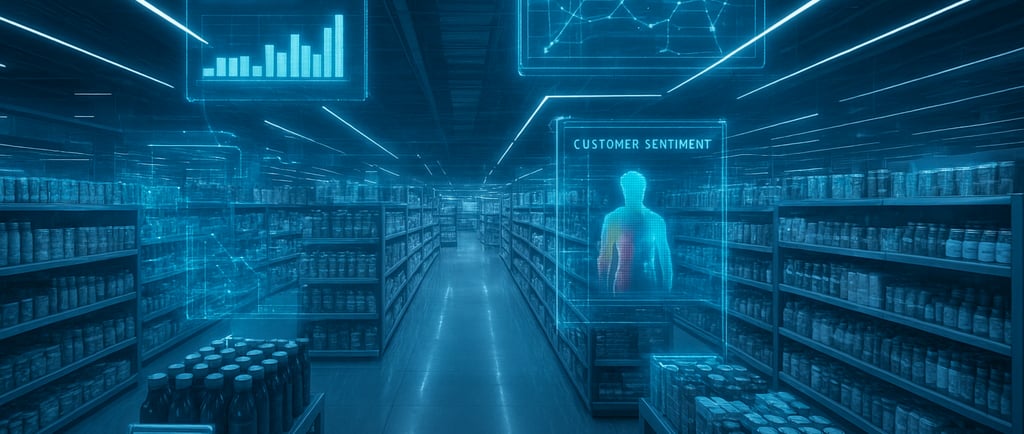
🧠 The Core Engine: Enterprise-Scale Retail Digital Twins (ERDT)
A true Retail Digital Twin is not a visualization tool or analytics layer.
It is a real-time, continuously learning mirror world - a fused simulation of the retailer’s physical and digital realities operating as one system.
🪞 What Makes ERDTs Different
Traditional digital twins model individual assets: a machine, a store, a warehouse.
An Enterprise-Scale Retail Digital Twin models the entire retail organism:
Stores, layouts, foot traffic, and shelves
Inventory flows and fulfillment networks
Supply chains, vendors, and logistics routes
Customer journeys across physical and digital touchpoints
Workforce activity and automation assets
External signals: weather, sentiment, economics, competitors
This is Retail 4.0’s decision intelligence fabric.
🧩 The Three Pillars of the Self-Learning Retail Enterprise
🟦 1. The Cognitive Layer — The Brain
Advanced AI and machine learning models are continuously:
Run millions of synthetic simulations
Predict demand, disruption, and customer behavior
Optimize outcomes across margin, experience, and resilience
Learn autonomously from every interaction
No static rules. No manual reprogramming.
🟨 2. The Sensor Texture - The Nervous System
A dense mesh of:
Computer vision
RFID and smart shelves
IoT and environmental sensors
Edge AI inference
This sensor fabric provides high-fidelity, real-time awareness of the physical world.
🟩 3. Autonomous Actuation - The Muscle
Decisions are executed directly into operation:
Prices adjust dynamically via Electronic Shelf Labeling
Inventory is rerouted automatically
Robots and autonomous vehicles are dispatched
Fulfillment workflows self-optimize
This is zero-touch retail orchestration.
🔵 From Reactive Management to Predictive Dominance
Retail 4.0 fundamentally changes how enterprises operate.
Instead of:
Monitoring dashboards
Reviewing weekly reports
Reacting to lagging KPIs
Retailers operate through continuous learning loops:
Sense - capture real-world signals
Simulate - test thousands of futures
Decide - select optimal actions
Act - execute autonomously
Learn - refine continuously
Over time, the enterprise becomes self-improving.
The retailer no longer runs the system.
The system learns how to run the retailer.
🏢 Strategic Use Cases for the C-Suite
🟦 Use Case 1: The Self-Healing Cognitive Supply Chain
A disruption hits - a port strike, weather anomaly, or viral demand surge.
ERDT Response:
Detects anomaly instantly
Simulates thousands of alternatives
Reroutes inventory automatically
Adjust regional pricing to shape demand
Issues supplier orders without escalation
All before a human meeting is scheduled.
🟨 Use Case 2: Algorithmic Merchandising & Dynamic Pricing
Instead of seasonal heuristics:
Computer vision tracks dwell time and engagement
Local economics and competitor signals are ingested
Demand elasticity is recalculated continuously
Prices and assortments adapt in real time
Merchandising becomes algorithmic, contextual, and margin-aware.
🟩 Use Case 3: Ambient, Hyper-Immersive Customer Experiences
The physical store becomes responsive:
Opt-in profiles personalize environments
Digital signage adapts dynamically
Smart fitting rooms anticipate needs
Physical and digital commerce dissolve into one experience layer
Retail becomes invisible, intuitive, and anticipatory.
🌍 Industry & Societal Impact
👥 Workforce Evolution
Roles shift from execution to supervision and design of autonomous systems:
Digital Twin Strategists
AI Operations Leaders
Human–AI Experience Architects
Responsible AI & Governance Officers
🌱 Sustainability by Design
ERDTs enable:
Emissions-aware logistics
Waste reduction through demand precision
Full traceability and ethical sourcing
🛍 Experience Without Friction
The best Retail 4.0 experiences will feel effortless:
No queues
No stockouts
No irrelevant offers
Just context-aware commerce.
🔵 Final Thought: Digital Twins Are the New Retail Operating System
Enterprise-scale retail digital twins are not tools.
They are becoming the operating system of Retail 4.0 - the foundation upon which autonomous, self-learning enterprises are built.
The future winners in retail will not be the largest chains or the most stores.
They will be the organizations that learn fastest, simulate best, and act autonomously.
Retail is no longer a place.
It is a living system.
Contact
Get in touch: connect@ea-chat.com
Subscribe
© 2024. All rights reserved.