Future of Retail: From Cloud AI to Edge Intelligence
Explore how the future of retail is evolving from cloud-dependent AI to ultra-fast, privacy-first edge intelligence. This article delves into how NPU technology is transforming physical stores into...
Imran Ahmad
11/30/20256 min read
AI at the Edge: How NPUs Are Powering the Sentient Store and Creating Frictionless Retail
Why the future of intelligent retail won’t be streamed from the cloud - it will be computed right at the shelf.
Introduction: Retail Innovation Is Stuck in the Latency Gap
Retail has spent nearly a decade chasing “phygital convergence”, combining digital insights with physical store experiences. Despite billions invested in smart shelves, customer analytics, and in-store automation, most shopping journeys remain frustratingly analog.
Stores have become data-rich but insight-poor. AI-driven personalization is often too slow. Smart checkout kiosks fail under traffic loads. Visual recognition tools pause, lag, or misidentify, and, worst of all, customer trust erodes when their data travels across distant servers.
The reason is simple:
Retail has been building real-time experiences on top of non-real-time architecture.
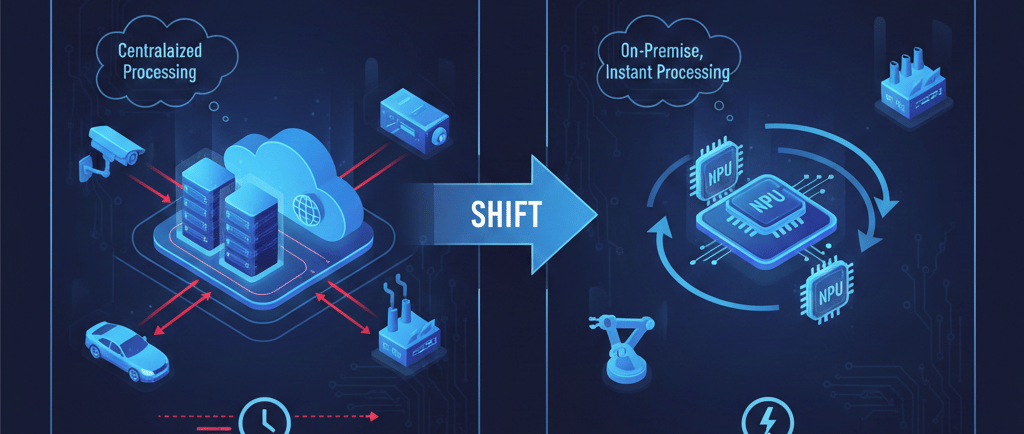
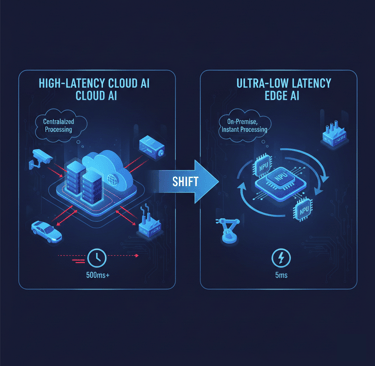
By offloading sensor and video data to centralized cloud systems, retailers hit a latency wall, often creating experiences slower than performing the tasks manually.
The next era of retail intelligence won’t be cloud-first. It will be edge-native. Enabled by a new class of purpose-built AI silicon: the Neural Processing Unit (NPU).
The Strategic Shift: From Cloud Intelligence to Ambient Edge Intelligence
Until now, cloud systems have dominated AI-driven retail. Whether for inventory forecasting or customer analytics, data flowed to centralized servers for interpretation. This structure made sense when edge hardware lacked the computational power to process advanced models locally.
Now, modern NPUs embedded into cameras, shelves, digital displays, and point-of-sale devices have changed what’s possible.
Retailers now benefit from edge-driven AI because it:
Reduces latency dramatically, enabling real-time reactions (e.g., detecting purchase intent before a decision).
Minimizes cloud dependency, saving bandwidth and operational costs.
Ensures privacy compliance, since raw visual data never leaves the store.
Improves resilience, allowing AI functionality to operate even during connectivity issues.
Enhances customer experience, delivering hyper-personalized interactions instantly.
In this new framework, the store itself becomes an intelligent computing environment—capable of sensing, thinking, and reacting without relying on remote cloud services.
What is an NPU and Why It’s Accelerating Retail Transformation
A Neural Processing Unit is an AI-specific chip designed to accelerate the matrix computations required by neural networks. Unlike general-purpose CPUs or performance-oriented but energy-heavy GPUs, NPUs are optimized for always-on inferencing at extremely low power requirements.
They make it feasible to run computer vision, gesture detection, speech recognition, and contextual modeling directly within edge devices.
This evolution is essential for today’s retail challenges because:
NPUs support TinyML, enabling machine learning models to run efficiently on small hardware.
They facilitate federated learning, allowing models to update using local data without exposing raw information.
Their high TOPS-per-watt efficiency allows continuous AI monitoring without overheating or excessive energy draw.
In other words, NPUs transform store equipment from passive input tools into active decision-making systems.
The Retail 2028 Shopper Journey: A Vision of Edge Intelligence
To understand how NPU-powered edge intelligence impacts the customer journey, consider the following scenario.
Entry: Hyper-Personalized Welcome
As the customer walks in, an entryway camera equipped with an NPU analyzes posture, attire, and perceived mood, not to identify them, but to understand their style and potential shopping preferences. Within milliseconds, nearby signage dynamically adjusts to show items that align with the customer’s style profile.
This hyper-personalized engagement happens without requiring app logins, QR scans, or any input from the customer.
It would be impossible at cloud latency speeds; edge NPUs make it instant.
Exploring Products: The Sentient Shelf
When the shopper pauses in front of two products, embedded sensors track gaze duration and hand proximity. The system detects hesitation and infers buying consideration. An adjacent micro-display instantly surfaces comparison information such as price differences, sustainability ratings, or recent feedback.
This is not triggered by an app or scan but by intent-aware AI modeled locally on the shelf device.
Checkout: Invisible, Privacy-First, Seamless
As the shopper exits with items, shelf sensors and vision systems reconcile what was picked up. Instead of sending raw camera feeds to cloud systems, only intent and transactional metadata are processed locally and matched using edge inferencing. Payment is completed through a pre-authorized wallet or card token.
No lines. No point-of-sale interaction. No personal data stored centrally.
Raw data is automatically cleared from the device’s memory post-transaction, satisfying privacy concerns and regulatory requirements.
Why Now: Market Pressures Driving This Shift
Edge AI powered by NPUs is gaining momentum because it solves multiple strategic challenges simultaneously.
Retailers are under pressure to:
Improve experiential quality and reduce friction.
Prevent loss proactively rather than reactively.
Support regulatory rules around AI transparency and data minimization.
Optimize sustainability efforts by reducing energy and network overhead.
Reduce operational costs tied to cloud infrastructure.
Edge-enabled AI helps with each of these goals by enabling immediate decision-making without streaming or storing massive amounts of video and sensor data.
Edge AI is rapidly becoming not just a technology upgrade, but a core business transformation tool.
How the Edge-AI Retail Architecture Works
The new intelligent retail architecture consists of four functional layers:
Hardware Edge Layer
Smart cameras, digital signage, shelf sensors, and advanced POS terminals equipped with NPUs.Local Inference Layer
AI models running directly on devices using TinyML frameworks and NPU accelerators. This layer handles real-time decisions such as gesture detection, product identification, and anomaly monitoring.Cloud Optimization Layer (Optional)
Long-term analytics, supply chain integration, demand forecasting, and large-scale model retraining. Only insight-level data is sent upstream.Enterprise Strategy & Ops Layer
Retail execution platforms, workforce coordination tools, and business intelligence systems leverage AI outputs without needing full sensor data.
Priority Use Cases for Immediate Retail Deployment
1. Intelligent Digital Signage
Displays content dynamically based on demographic and behavioral cues. Edge computing ensures instant relevance without losing privacy.
2. Autonomous Checkout and Scan-Less Carting
Shelf and camera systems infer what has been selected. No manual scanning required.
3. Real-Time Shelf Health Monitoring
NPU-equipped sensors identify low stock or improper display positioning before it affects sales.
4. Theft and Shrink Prevention
Always-on edge models detect high-risk patterns and alert staff discreetly without centralized surveillance concerns.
5. Workforce Optimization
Edge-based traffic insights predict peak times and dynamically recommend staff allocation.
Strategic Benefits to the Enterprise
Edge NPUs introduce critical advantages across multiple metrics:
Customer Experience: Sub-10 millisecond interaction speeds make digital moments feel like human intuition.
Operational Continuity: AI runs even during WAN/calibration outages.
Data Governance: Local data processing ensures low liability and tighter privacy control.
Efficiency Gains: Less dependency on centralized processing reduces cost and energy.
Sustainability Credibility: Edge processing consumes less power than cloud-connected systems for the same workload.
This shift marks a move from responsive retail to anticipatory commerce.
Implementation Challenges and How to Overcome Them
While the technology is transformational, scaling edge-AI stores requires thoughtful planning:
Legacy environment complexity: Start with modular retrofits rather than full redevelopment.
Hardware vendor fragmentation: Select silicon partners with established AI SDKs and long-term platform support.
Model lifecycle management: Establish governance around quantization, edge deployments, and federated updates.
Data privacy interpretation: Build compliance around “privacy by inference” where only metadata is retained.
Talent skills gap: Partner with edge AI innovators until in-house AI Ops maturity improves.
How to Begin: Executive-Level Deployment Roadmap
Phase 1: Strategic Assessment (0–3 Months)
Identify key physical interaction points where latency limits performance.
Define edge AI objectives: friction removal, shrink reduction, revenue enhancement.
Engage silicon and IoT partners who support edge inferencing and federated learning.
Phase 2: Pilot Deployment (3–12 Months)
Select one store type or region for initial testing.
Choose 1–2 flagship use cases, such as shelf intelligence or predictive kiosk personalization.
Track metrics including conversion rate, dwell time, shrink improvement, and time-to-checkout.
Phase 3: Full Rollout (12–24 Months)
Standardize edge hardware configurations across locations.
Integrate decision intelligence into store SOPs and workforce planning systems.
Monitor and iterate based on real-time behavioral and operational insights.
Performance Metrics to Track
To measure success, senior leaders should monitor:
Time from customer interaction to AI response (target: under 10ms)
Reduction in queue or checkout times
Conversion uplift per customer interaction
Shrink percentage improvement
Energy impact per AI-enabled device
Percentage of decisions autonomously made at the edge vs in cloud
Executive Calls to Action
For CIOs/CTOs:
Initiate development of an Edge AI retail blueprint that defines future infrastructure requirements and includes NPU-specific deployment standards.
For Chief Innovation and Strategy Officers:
Launch a “Sentient Store” pilot program focused on one high-traffic location, capturing the full edge-AI experience.
For CFOs:
Model hybrid ROI outcomes combining revenue uplift (from enhanced customer engagement) and operational cost reductions (from loss prevention and energy savings).
For Operations Leaders:
Create new operating procedures that blend human decision-making with real-time AI signals, especially around shelf maintenance, workforce mobilization, and customer support.
Looking Toward 2030: The Emergence of Cognitive Retail Environments
By 2030, leading stores will not require customers to engage with technology. Instead, technology will respond fluidly to customer behavior and intent.
The store will:
Detect and react to product interest before action is taken.
Allocate staffing based on traffic projections rather than guesswork.
Dynamically alter pricing or promotions based on local purchase signals.
Learn continuously from every interaction without exporting sensitive data.
Become fully operational, even during network outages.
This is not automation; it is cognition. And retailers who shift now will own the next digital transformation wave.
Final Thought
The next generation of retail leaders won’t simply manage customer data. They will orchestrate real-time intelligence at the point of experience. Success will be defined not by the volume of data processed, but by how intelligently and locally it’s used.
The real revolution will not be cloud-enabled. It will be computed within the store itself — in milliseconds, without leaving the shelf edge.
Contact
Get in touch: connect@ea-chat.com
Subscribe
© 2024. All rights reserved.